How the Island of Smögen in Sweden Turned into the Island of Light

Updated: Jul 21
Off Sweden's west coast, the fishing island of Smögen is known for its colorful boathouses and its slabs of pink granite, worn smooth by ice ages long past. For ten nights every September, it becomes something else: an open-air space with no walls, no ceiling, no fixed floor plan. Just rocks, sea, sky, and light.
The idea came from one person's evening walks. Years ago Dulce Sales Ahlberg ran a gallery on Smögen, and after closing up she would walk the island's granite paths at dusk. Somewhere in those walks, the island itself began to look like an exhibition space. "I just started to see how art can be projected, how it can go through holes," she says, describing how the rocks seemed to open into room after room, each one giving into the sea. She thought that "this was like an enormous, majestic art hall filled with art."

That was 2018. Roughly 30,000 people showed up for the first edition, a striking number for a festival held on a small island, and one that made clear the idea had touched something real. This September, from the 4th to the 13th, Island of Light opens its seventh edition, with artists from France, Poland, Greece, Finland, England, the Netherlands, Latvia and Sweden, organized under the non-profit association Smögen Art-Light Festival, which Dulce founded and still directs.
She's candid about what was driving her before the idea for a light festival ever took shape: frustration with who does and doesn't walk through a gallery door. "There's so many people that, for whatever reason, they never come in contact" with art, she says. She isn't against the conventional gallery, she ran one herself, but she wanted to reach past it. Taking work outside, onto rocks and docks people were already walking across, meant they could have what she calls "their first art experience" without ever deciding in advance to have one. She's watched that happen more than once. People crying in front of an art installation. Someone was telling her afterwards, unprompted: "I did not know I liked art."
She draws a hard line, more than once, between what she and the team are building and what already exists elsewhere in Sweden. Asked to compare Island of Light to Sweden's long-running Lights in Alingsås, she doesn't hedge: "Certainly, Lights in Alingsås is really beautiful, but it is lighting, not light art." The distinction matters to her. "New York, Berlin, Sydney and other global cities usually put on this kind of festival," she has said elsewhere. "It's the first time that it takes place in harmony with nature in a setting like this one."
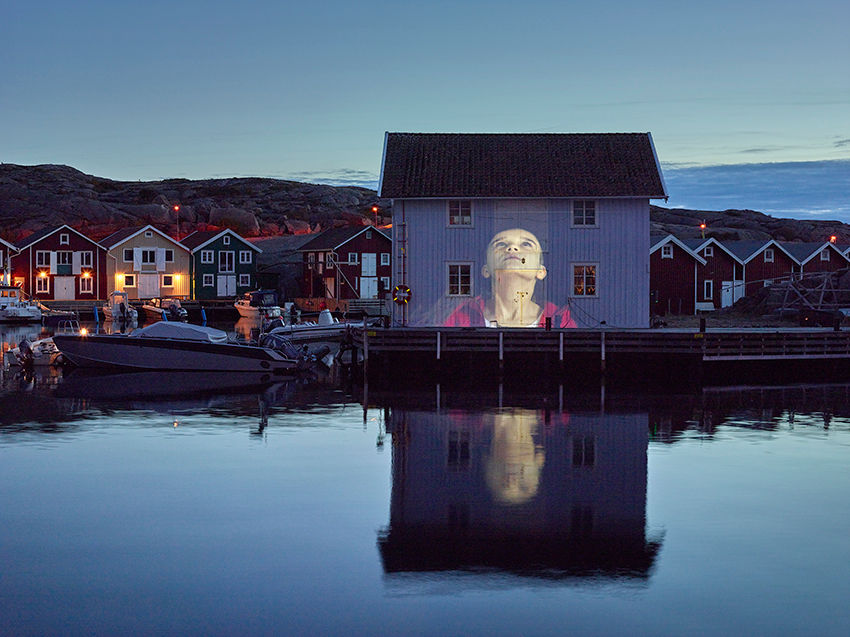
Weather had a say in the medium, too. "We sometimes have rough weather here in Sweden, winds and rain," she says, not ideal conditions for live music or anything fragile. Light, projected onto stone, could hold up. But durability was never really the point; the relationship between the work and the place was. "It's not that an art piece will be put on the rock," she says. "The artist will create a piece for this space. They weave the space." She keeps returning to the concept of "weaving" art with nature: "it is 100% site-specific," she says. "That's the whole point." That pairing, for her, is also a meeting across time. "In these rocks you can see the traces from an ice age," she says, describing striations left by glaciers thousands of years old. "And within the festival, the now and the past come together."
"We see interest in the Island of Light growing every year. This year's festival is larger than ever, featuring renowned artists from across the globe. It will be ten days filled with extraordinary light art and unforgettable experiences. Interest has been tremendous, and we expect record-breaking attendance this year."
The centerpiece of this year's program is a major new work from the French artist Miguel Chevalier, a pioneer of generative and virtual art since the late 1970s. His piece, Post-Natural: Living Plankton, is a monumental site-specific installation inspired by plankton, modeled with algae and organic plant forms in 3D, and projected directly onto Smögen's pink granite, with an original soundscape by Claude Micheli. "The inspiration for this work comes from plankton, which forms the foundation of the marine food chain and plays a crucial role in the climate by producing a significant share of the oxygen we breathe," Chevalier says. "What makes a place like Smögen so fascinating is how the work interacts with the elements of nature: the waves, the wind, the darkness, and the surfaces of the cliffs. The projection becomes alive and organic, almost as if it were part of nature itself."

Around it, the program spreads out across the island like variations on a theme: kinetic, recycled-material sculpture from Finland's Emma Rönnholm; site-specific, socially engaged light works from Poland's Robert Sochacki; a shamanic performance from Wales-based collaborators Craig Morrison and Ant Dickinson, joined by Norwegian dancer Ann-Kathrin Granhus; large-scale installations from the Riga-based collective Those Guys Lighting; and, from the British brothers behind Illuminos, a nomadic audiovisual work projected directly onto a moving fishing boat. Greek artist Theodora "Dorina" Salti brings an interactive, live-performed audiovisual piece, while Dutch designer Eric Langendoen and Swedish artist Aleksandra Stratimirovic, part of the festival's creative team since its earliest edition, contribute site-specific works exploring how light shapes public space. Finnish artist Anni Laukka builds an installation from materials sourced through the Marin Recycling Center, then projects its shadow onto the wall of one of the boathouses on Smögens Pier. A Light Walk choreographed by technical director Emma-Kara Nilsson, made with students from the Performing Arts School of Gothenburg, threads through the island, while an Open Sky Cinema, produced with Naturfilmarna, the International Sami Film Institute, and the French photographer and director Yann Arthus-Bertrand, screens films directly onto the cliffs after dark.

While international light art remains at the heart of the festival, much of its identity is rooted in the unique environment of Bohuslän and local initiatives. Materials such as marine plastic and discarded fishing gear, collected in collaboration with Sotenäs Municipality, have been incorporated into several installations and become part of the festival's visual expression.
"Art has a unique ability to draw attention to issues we might otherwise overlook. During this year's festival, several installations will explore humanity's impact on marine ecosystems and examine the relationship between nature, the sea, and contemporary society."
Island of Light runs from 4 to 13 September 2026 on the island of Smögen, Sweden. Full program details are available at www.islandoflight.art.
About Island of Light
Island of Light is an internationally acclaimed light art festival that each year transforms Smögen into a unique meeting place for art, light and immersive experiences. The festival brings together Swedish and international artists through spectacular installations along the Bohuslän coast, attracting more than 20,000 visitors annually from Sweden and around the world. Since its inaugural edition in 2018, Island of Light has established itself as one of the most prominent light festivals in the Nordic region.


